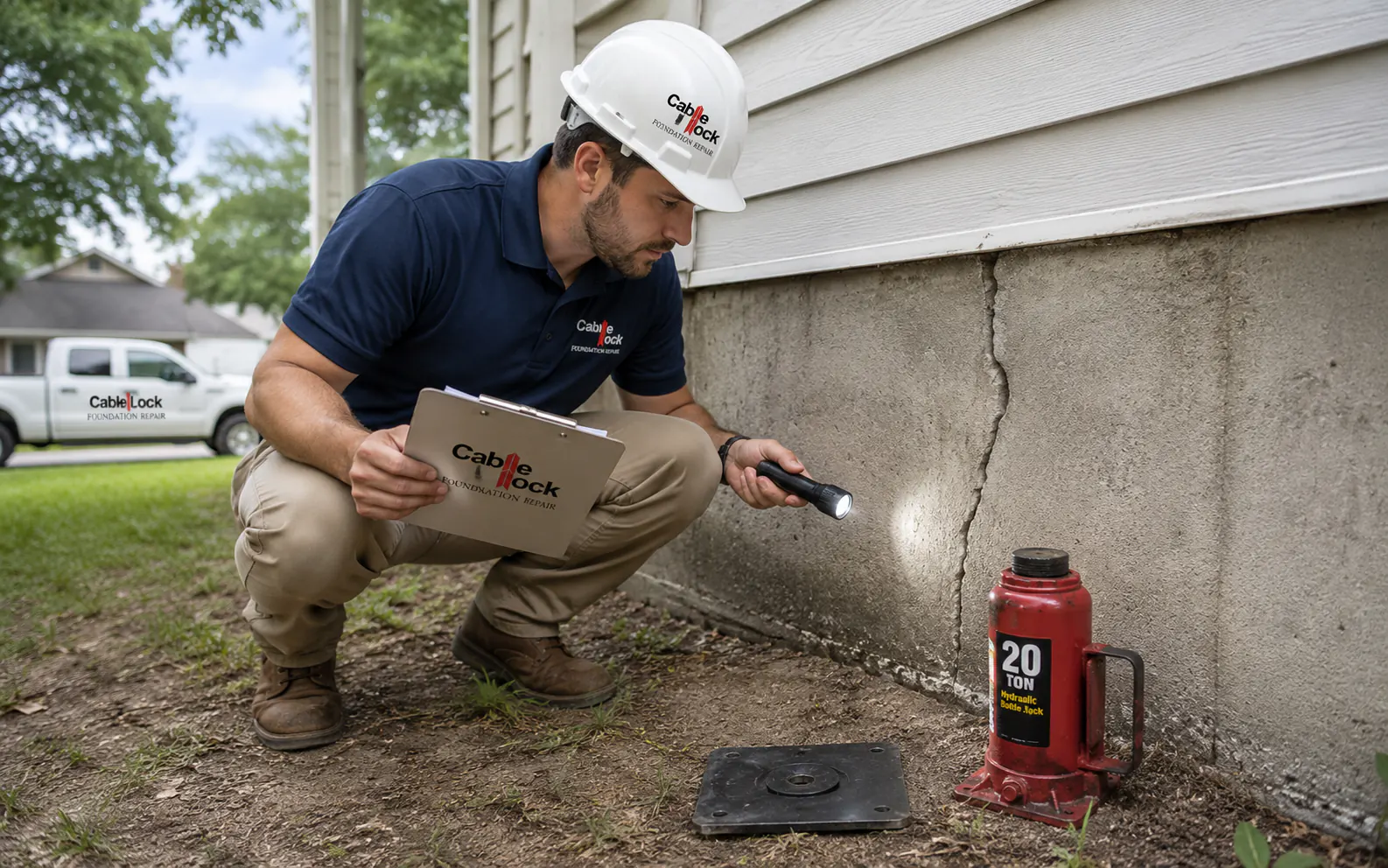
Foundation damage from hurricane season is Southeast Louisiana’s most misunderstood home problem — because the worst of it doesn’t happen during the storm. It happens in the weeks and months after one, when no one is watching. Every June, homeowners stock the pantry, fill the bathtub, move the lawn furniture inside, and wait. When the power flickers back on and the ceilings are dry, most people breathe a sigh of relief. What they don’t check — and what quietly causes thousands of dollars in damage — is what happened underneath the house.
Louisiana’s soil is unlike almost anywhere else in the country. The Mississippi River Delta sediments beneath New Orleans, Metairie, Slidell, and the River Parishes are young, soft, and rich in clay. They behave more like a sponge than solid ground — absorbing water when the rains come, then shrinking and cracking when the summer heat bakes them dry. A major hurricane doesn’t just bring wind. It deposits enormous amounts of water into already-saturated soils, then leaves. And when the water recedes and the ground dries out unevenly, the foundation beneath your home moves with it. Louisiana’s clay-rich soils make foundation damage from hurricane season far more severe here than anywhere else in the country — and far more delayed. Understanding why foundation damage hurricane season causes in Louisiana is different from what happens in other states starts with what’s actually under your home.
“The storm gets the headlines. The foundation damage shows up quietly — in a door that sticks three months later, or a floor that wasn’t sloped before.”
Why Louisiana’s Clay Soil Makes Every Hurricane a Foundation Event
To understand why hurricanes are especially hard on local foundations, you need to understand what’s actually under your home. Unlike most of the country, where builders can anchor foundations into stable bedrock relatively close to the surface, Southeast Louisiana homes sit on layers of river delta sediment that can extend hundreds of feet deep. These sediments — heavy in clay, silt, and organic peat — are inherently compressible. They move.
Clay soils have a specific property that engineers call “shrink-swell behavior.” When clay absorbs water, it expands. When it dries out, it contracts. In a place like Louisiana — which experiences both tropical deluges and intense summer heat — this cycle is extreme. During a normal year, the seasonal movement of clay soils is already working against your foundation. During a hurricane year, that cycle gets dramatically amplified.
Here’s the sequence that causes damage:
SPRING / PRE-SEASON: Soils are at variable moisture levels. Any existing foundation movement from previous years is already present. This is the ideal time for a preventive inspection.
STORM ARRIVAL: Soil becomes fully saturated. Storm surge, flooding, and heavy rain push water deep into the clay layers. The soil swells, and this expansion can shift piers, push against foundations, and create uneven pressure across the structure. This is the moment foundation damage hurricane season delivers — saturated soil swells unevenly, shifting piers and slabs before a single crack appears on your walls.
WEEKS AFTER THE STORM (Danger Zone): Water recedes unevenly — the east side of a slab may dry faster than the west. As soil contracts at different rates, piers settle at different rates. This differential movement is what cracks walls, bows floors, and jams doors.
LATE FALL / WINTER: Symptoms become visible months later. Homeowners notice new cracks, sticking doors, or sloped floors and often don’t connect them to the storm that passed earlier in the year.
This delayed timeline is one of the most misunderstood aspects of post-hurricane foundation damage in Louisiana. The storm itself isn’t what breaks your foundation — it’s the aftermath, the uneven drying, the differential settling, the movement no one sees because it happens inches at a time underground.
Pro tip: Some parts of New Orleans East have been documented sinking at rates of up to 1.5 inches per year even without hurricanes — more than five times the regional average. After a major storm saturates those soils, the movement compounds. For homeowners in these areas, a post-storm inspection isn’t optional — it’s essential.
The 5 Post-Storm Warning Signs Specific to Southeast Louisiana Homes
These are the signs that experienced foundation professionals look for in the weeks and months after a named storm. Most can be spotted with a careful walk-through of your home — no tools required.
1. Doors and windows that suddenly stick or won’t latch When the framing around a door or window shifts even a fraction of an inch, the door binds. If you have doors or windows that worked fine before the storm and now require force, that’s not humidity — that’s movement in the structure.
2. New diagonal cracks at the corners of door or window openings These “stair-step” cracks — especially visible in brick exteriors along the mortar lines — are a direct signature of differential settlement. The diagonal pattern reflects the way forces travel through a structure when one part sinks more than another. Horizontal cracks are also serious and should be evaluated immediately.
3. Floors that feel uneven, springy, or have a visible slope A marble test is surprisingly effective: place a marble on a hard floor and see if it rolls. More than an inch of slope across a room is worth having evaluated. Raised pier-and-beam homes are especially susceptible — the wooden beams and piers can shift or rot when subjected to prolonged moisture.
4. Gaps opening between walls and the ceiling or baseboards When a foundation settles unevenly, the wall framing moves with it but the ceiling may not — or vice versa. Gaps larger than a hairline appearing along the top or bottom of a wall are a red flag, especially if they appeared after the storm season.
5. New moisture, standing water, or musty smell in a crawl space If your home has a pier-and-beam foundation with a crawl space, get underneath it after every significant storm. Standing water that lingers for days accelerates wood rot on beams, attracts pests, and allows the soil below to remain saturated — extending the window of foundation movement.
Any of these five signs appearing in the months after a storm is a strong indicator of hurricane season foundation damage. Hurricane season in Louisiana creates conditions no other region faces — act on these warnings early.
Pro tip: Walk through your home with your phone camera pointed at the corners of door frames, along baseboards, and at ceiling-wall junctions. Take dated photos now, before storm season. Comparative photos taken 60 to 90 days after a storm are among the most useful tools a foundation inspector can work with.
Pier-and-Beam vs. Slab: Which Louisiana Foundation Type Is More Vulnerable?
Southeast Louisiana has a mix of both foundation types, and each faces different threats during and after hurricane season.
Pier-and-beam foundations
These are extremely common in older New Orleans neighborhoods — the classic raised shotgun house or Creole cottage sits on a grid of concrete or brick piers. The advantage is that they allow air circulation beneath the home and can be more easily leveled and adjusted. The disadvantage is that individual piers can shift, sink, or heave independently during a soil-saturation event. After a major storm, a pier-and-beam home can develop “soft spots” in the floor — areas where a beam is no longer fully supported — within weeks.
Slab-on-grade foundations
More common in post-WWII suburbs like Metairie, Kenner, Chalmette, and newer parts of the West Bank, slab foundations feel solid but are actually more vulnerable to differential settlement. When the soil beneath one part of a slab washes away, erodes, or compacts unevenly, the concrete doesn’t flex — it cracks. A cracked slab in a flooded area can admit groundwater directly into the home’s interior even after floodwaters recede.
Both foundation types benefit from the same preventive principle: getting water away from the foundation perimeter as quickly as possible after a storm, and ensuring that drainage is directing water away from — not toward — the structure.
What to Do Right Now, Before Hurricane Season Peaks
The good news: foundation damage hurricane season triggers is almost always preventable or caught early with the right inspection — especially if you act before June 1. Hurricane season officially runs June 1 through November 30, with the statistical peak around September 10. That means the spring months — particularly March through May — are the practical window for smart homeowners to get ahead of potential problems.
Schedule a foundation inspection
A professional evaluation by a licensed foundation repair company is the baseline. An experienced eye can identify subtle signs of movement that haven’t yet caused visible damage. In many cases, small corrections made before a storm are dramatically cheaper than major repairs made after one. Cable Lock Foundation Repair offers free estimates for Southeast Louisiana homeowners throughout the Greater New Orleans and Baton Rouge areas.
Audit your drainage
Walk the perimeter of your home after a heavy rain. Is water pooling against the foundation? Are downspouts discharging more than four feet from the foundation wall? Is there any grading that slopes toward the house rather than away? Any of these conditions accelerate soil saturation during a storm — and they’re usually inexpensive to correct before the season begins.
Inspect your gutters and downspouts
A clogged gutter during a Category 1 rainstorm can dump thousands of gallons of water directly against a foundation in a matter of hours. Clean gutters before June. If your downspouts terminate within two feet of the house, extend them or add splash blocks.
Know your soil moisture history
Southeast Louisiana went through a notably dry stretch in spring 2024 before the active storm season. Prolonged dryness causes clay soils to contract and crack — sometimes dramatically. When the first heavy rains then arrive, water rushes into those cracks and can cause rapid, uneven expansion. If your area has been unusually dry entering storm season, your foundation is already under stress before any storm arrives.
Document your home’s current condition Take photos. Corner cracks, floor levels, door frame alignment. Date them. If a storm later causes or accelerates damage, documented “before” conditions are invaluable for insurance claims and for understanding the scope of repair needed.
Frequently Asked Questions
Q: How does hurricane season damage foundations in Louisiana?
A: Hurricanes saturate Louisiana’s clay-heavy soils with massive amounts of water, causing them to expand and shift beneath your foundation. When the storm passes and summer heat returns, the same soil contracts rapidly. This wet-dry cycle creates uneven pressure on foundation piers, leading to cracking, settling, and tilting — often weeks or months after the storm itself.
Q: How long after a hurricane should I have my foundation inspected?
A: Ideally, schedule an inspection within 30 to 90 days after a major storm. Some soil movement takes weeks to become visible as the ground dries unevenly. Don’t wait for obvious structural damage — catching movement early makes repairs significantly less expensive.
Q: Does homeowner’s insurance cover foundation damage from hurricanes in Louisiana?
A: Standard homeowner’s insurance typically does not cover foundation settling or soil-movement damage, even after a named storm. Flood insurance may cover direct structural flood damage, but coverage for gradual subsidence or soil shift is usually excluded. A foundation inspection report documenting storm-related damage can support any claim you do file.
Q: What is the best foundation repair method for Louisiana’s clay soil?
A: In Southeast Louisiana, the Cable Lock piling system and steel push piers are among the most effective methods. These systems drive past the unstable upper clay layers — which shift with moisture — down to deeper, more stable soil strata, addressing the root cause rather than just patching surface symptoms.
Q: Can tree roots near my home make hurricane foundation damage worse?
A: Yes. Large trees draw moisture from clay soil during dry periods, which can cause localized soil shrinkage near the foundation. After a hurricane saturates the same area, the soil rebounds rapidly and unevenly. If you have mature trees within 10 to 15 feet of your foundation, their root zones should be part of any post-storm inspection. Root barrier installation is one of Cable Lock’s services for exactly this reason.
Don’t wait until you see cracks. A free foundation inspection before storm season is the best investment a Southeast Louisiana homeowner can make. Our experienced crews serve New Orleans, Metairie, Slidell, Baton Rouge, and surrounding parishes — and we’ve been doing this since 1997, long before Katrina put Louisiana foundations on the national map.
Call us today: New Orleans: (504) 828-2223 Baton Rouge: (225) 273-2525 Or schedule your free inspection at cablelockfoundation.com.